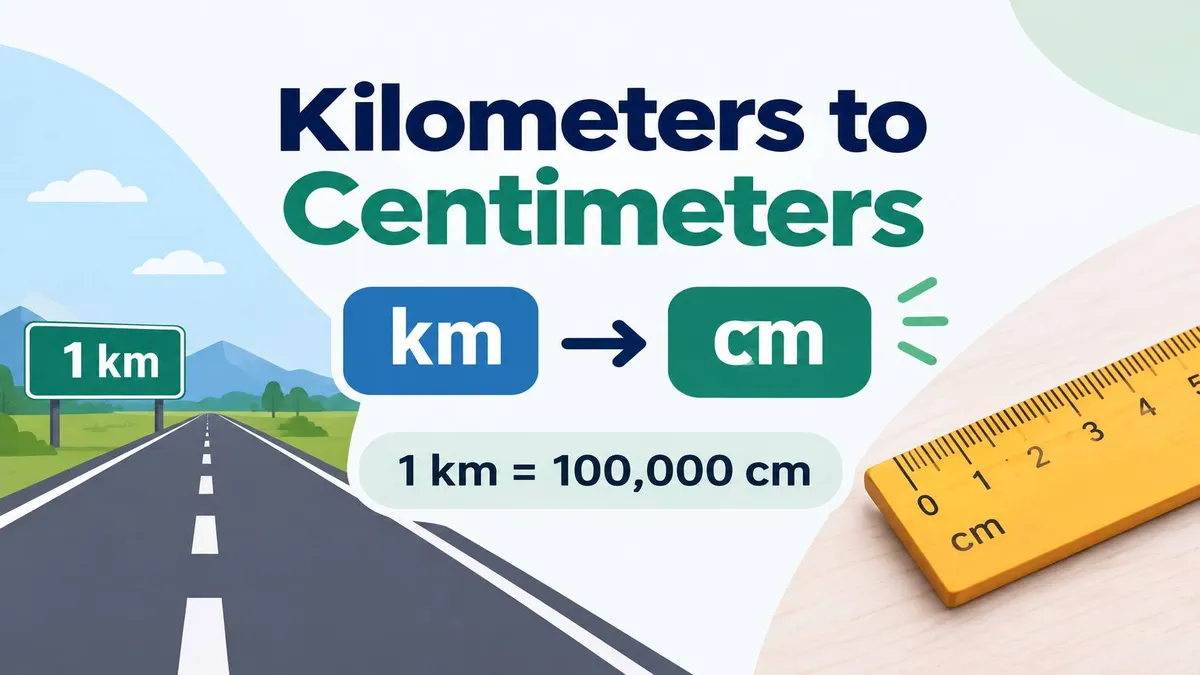
Kilometers to Centimeters (km to cm): Formula & Chart
How Many Centimeters Are in a Kilometer?
There are exactly 100,000 centimeters in 1 kilometer. To convert kilometers to centimeters, multiply the number of kilometers by 100,000. So 5 km equals 500,000 cm, and 0.5 km equals 50,000 cm. To convert centimeters to kilometers, divide by 100,000.
This is an exact value, not a rounded one. It comes from the definitions of the metric prefixes, so it is the same in every country and every tool.
If you only need a quick answer, the SmartConvertMax unit converter is free and needs no signup. If you want to understand where the number comes from and how to avoid costly mix-ups, read on.
The Kilometers to Centimeters Formula
The formula is short enough to memorize:
centimeters = kilometers × 100,000
The reverse is just as simple:
kilometers = centimeters ÷ 100,000
Direction | Formula | Example |
|---|---|---|
Kilometers → Centimeters | km × 100,000 | 3 km = 300,000 cm |
Centimeters → Kilometers | cm ÷ 100,000 | 300,000 cm = 3 km |
You may also see the reverse written as a multiplication: 1 cm = 0.00001 km. Both versions give the same result, but dividing by 100,000 is easier to do in your head.
How to Convert Km to Cm Step by Step
Here is the manual method. It works for whole numbers and decimals alike.
Write down the distance in kilometers. For example, 3.75 km.
Multiply by 100,000. 3.75 × 100,000 = 375,000.
Add the unit. The answer is 375,000 centimeters.
Check your work. Divide 375,000 by 100,000 and you should get 3.75 again.
That last step takes five seconds and catches most arithmetic slips. Make it a habit for anything that matters, such as an exam answer or a construction drawing.
The Decimal Shift Shortcut
Because the metric system runs on powers of 10, you do not need a calculator. Multiplying by 100,000 simply moves the decimal point five places to the right, adding zeros where needed.
2 km → 200,000 cm
0.5 km → 50,000 cm
8.2 km → 820,000 cm
0.04 km → 4,000 cm
For the reverse, move the decimal five places to the left. 750,000 cm becomes 7.5 km.
Why Is 1 km Equal to 100,000 cm?
The answer comes straight from the metric prefixes. “Kilo” means 1,000, so 1 km is 1,000 meters. “Centi” means one hundredth, so 1 cm is 0.01 meters, which means every meter holds 100 centimeters.
Put the two together and you get 1,000 × 100 = 100,000. Moving from kilo to centi means moving five decimal places: three from kilo down to the base unit, and two more from the base unit down to centi.
Metric Prefix Chart for Length
This chart shows the common length prefixes and how each compares with the centimeter. It is the clearest way to see where 100,000 comes from.
Prefix | Symbol | Factor (in meters) | Example | In centimeters |
|---|---|---|---|---|
kilo | km | 1,000 | 1 km | 100,000 cm |
hecto | hm | 100 | 1 hm | 10,000 cm |
deca | dam | 10 | 1 dam | 1,000 cm |
(base unit) | m | 1 | 1 m | 100 cm |
deci | dm | 0.1 | 1 dm | 10 cm |
centi | cm | 0.01 | 1 cm | 1 cm |
milli | mm | 0.001 | 1 mm | 0.1 cm |
Each step down the table multiplies by 10, and each step up divides by 10. From kilometer to centimeter is five steps, and 10 × 10 × 10 × 10 × 10 equals 100,000.
The BIPM SI Brochure is the official international reference for these prefixes. In the United States, NIST Special Publication 811 documents the same rules, and ISO 80000-3 is the international standard for quantities and units of space and time.
Understanding the Kilometer and the Centimeter
A kilometer is a metric unit equal to 1,000 meters. It is the standard unit for long distances in almost every country outside the United States and the United Kingdom. You see it on road signs, in race distances like 5K and 10K, and in GPS directions. The kilometre article on Wikipedia gives a good overview of its history and use.
A centimeter is a metric unit equal to 0.01 meters, or 10 millimeters. It is the everyday unit for small measurements such as clothing sizes, furniture dimensions, human height and map scales. A fingernail is roughly 1 cm wide. The centimetre article covers the unit in more detail.
Both unit names have a British spelling: kilometre and centimetre. Only the spelling differs. The conversion, 1 km = 100,000 cm, is identical.
Kilometers to Centimeters Conversion Table
These are the values people look up most often.
Kilometers (km) | Centimeters (cm) |
|---|---|
0.001 | 100 |
0.01 | 1,000 |
0.1 | 10,000 |
0.25 | 25,000 |
0.5 | 50,000 |
1 | 100,000 |
1.5 | 150,000 |
2 | 200,000 |
2.5 | 250,000 |
3 | 300,000 |
5 | 500,000 |
7.5 | 750,000 |
10 | 1,000,000 |
21.0975 (half marathon) | 2,109,750 |
42.195 (marathon) | 4,219,500 |
100 | 10,000,000 |
For a value that is not listed, use the decimal shift method above or the unit converter, which returns the exact figure instantly.
Centimeters to Kilometers: The Reverse Conversion
Going from centimeters back to kilometers is common in construction, model-making and science homework. The rule is to divide by 100,000.
Centimeters (cm) | Kilometers (km) |
|---|---|
1 | 0.00001 |
150 | 0.0015 |
10,000 | 0.1 |
50,000 | 0.5 |
100,000 | 1 |
250,000 | 2.5 |
500,000 | 5 |
1,000,000 | 10 |
Here is a quick example. A survey tape reads 87,500 cm. Divide by 100,000 and you get 0.875 km, which is 875 meters. If you need meters only, divide by 100 instead.
Kilometers to Other Metric Units
Many people who look up km to cm also need the neighboring units. Here is 1 kilometer in each of them:
Unit | 1 kilometer equals |
|---|---|
Meters (m) | 1,000 |
Centimeters (cm) | 100,000 |
Millimeters (mm) | 1,000,000 |
So to convert kilometers to millimeters, multiply by 1,000,000. To convert meters to centimeters, multiply by 100. To convert centimeters to millimeters, multiply by 10. Our guides on kilometers to meters and centimeters to millimeters cover those steps in detail.
If you also work in imperial units, 1 mile equals exactly 1.609344 km, which is 160,934.4 cm. For those conversions, see our guides on miles to kilometers, kilometers to feet, meters to feet, centimeters to feet and inches to centimeters.
Km to Cm in Real Life
A conversion factor is easier to trust when you can picture it. Here is where it shows up outside the classroom.
Km to Cm for Map Scales
Map scales are the most practical use of this conversion. A scale of 1:100,000 means that 1 cm on the map represents 100,000 cm in real life. Since 100,000 cm is exactly 1 km, 1 cm on the map equals 1 km on the ground.
The same logic works for other common scales:
1:25,000: 1 cm on the map = 25,000 cm = 0.25 km (250 m)
1:50,000: 1 cm on the map = 50,000 cm = 0.5 km (500 m)
1:100,000: 1 cm on the map = 100,000 cm = 1 km
1:250,000: 1 cm on the map = 250,000 cm = 2.5 km
For example, if two towns are 7.5 cm apart on a 1:100,000 map, they are 7.5 km apart in reality. If your distances are on a scanned map or a photographed chart, the OCR image tool can extract the printed numbers so you do not have to retype them.
Km to Cm for Construction and Engineering
Long projects such as roads, pipelines and railways are planned in kilometers, while detailed drawings use centimeters or millimeters. A 2.5 km road is 250,000 cm of surface. A 1 km pipe run is 100,000 cm of material.
Mixing up units here is expensive. A “5 km” figure read as “5 cm” would be off by a factor of 100,000, which is why engineers write the unit next to every number.
The rules for measurement in US trade and commerce are published in NIST Handbook 44. In the UK, the legal basis for metric units is the Weights and Measures Act 1985, and the National Physical Laboratory serves as the national measurement institute.
Km to Cm for School and Science
Physics, chemistry and biology are done in SI units, so students regularly convert between prefixes. A typical exam question might read: “A sound wave travels 0.34 km in one second. How many centimeters is that?” The answer is 0.34 × 100,000 = 34,000 cm.
Here is a picture that helps. A standard ruler is 30 cm long, so a kilometer is about 3,333 of those rulers laid end to end. That makes the size of the unit easier to feel.
Running Distances in Centimeters
Race distances are always quoted in kilometers, but converting them shows how large the centimeter count gets.
Race | Kilometers | Centimeters |
|---|---|---|
1K | 1 | 100,000 |
5K | 5 | 500,000 |
10K | 10 | 1,000,000 |
Half marathon | 21.0975 | 2,109,750 |
Marathon | 42.195 | 4,219,500 |
So a 5K race is 500,000 cm, and a marathon is 4,219,500 cm. Nobody measures a race this way, but the numbers show how small a centimeter is next to a kilometer.
Kilometer vs Meter vs Centimeter
Seeing all three units side by side helps lock in the scale.
Unit | Symbol | Equal to | Typical use |
|---|---|---|---|
Kilometer | km | 1,000 m = 100,000 cm | Roads, races, travel |
Meter | m | 100 cm = 1,000 mm | Room sizes, height, fabric |
Centimeter | cm | 0.01 m = 10 mm | Rulers, clothing, small objects |
A doorway is about 200 cm tall. A kilometer is the length of roughly 500 doorways stacked end to end, or 100,000 fingernails laid side by side.
Common Mistakes When Converting Km to Cm
Most errors come from a handful of habits:
Using 1,000 or 100 instead of 100,000. Stopping after one prefix step is the most common slip. A kilometer is 1,000 meters, but you still need to turn those meters into centimeters.
Dropping a zero. 100,000 has five zeros. Writing 10,000 gives a result ten times too small.
Multiplying when you should divide. Going from the larger unit (km) to the smaller one (cm) always gives a bigger number. If your answer got smaller, something went wrong.
Slipping the decimal. 0.5 km is 50,000 cm, not 5,000 cm. Move the decimal exactly five places.
Mixing up kilo and centi. The two prefixes are 100,000 times apart. Confusing them turns a 5 km run into a 5 cm crawl.
A good safeguard is to write the unit next to every number as you work.
A Short History of the Metric System
The metric system was developed in France in the 1790s, during the French Revolution. The aim was to replace a patchwork of local measures with one decimal system. The meter was first tied to the size of the Earth, and since 1983 it has been defined by the speed of light in a vacuum.
Today almost every country uses the metric system for official measurement. The United States relies on it heavily in science, medicine and manufacturing, even though road signs still use miles. Through all of this, the ratio of 1 km to 100,000 cm has never changed.
How to Convert Kilometers to Centimeters in Excel
Spreadsheets are the easiest way to convert a long list of values. In Excel or Google Sheets, put the kilometer value in cell A1 and use either of these formulas:
Multiplication:
=A1*100000Built-in function:
=CONVERT(A1,"km","cm")
To go from centimeters back to kilometers, use =A1/100000 or =CONVERT(A1,"cm","km"). Drag the formula down the column to convert the whole list at once.
Other Ways to Convert Kilometers to Centimeters
Depending on the situation, you have several options:
Online unit converter: The SmartConvertMax unit converter is free, works in your browser and needs no software.
Mental math: Move the decimal five places to the right. This is fastest for round numbers.
Scientific calculator: Multiply by 100,000, or enter 1E5 using the scientific notation key.
Voice assistant: Asking “How many cm in a km?” gets a spoken answer in seconds.
Frequently Asked Questions
How many cm in a km?
There are exactly 100,000 centimeters in 1 kilometer. This comes from 1 km = 1,000 m and 1 m = 100 cm.
How many centimeters in a kilometer?
The answer is 100,000. It is an exact value because it follows directly from the definitions of the kilo and centi prefixes.
Is 1 km equal to 100,000 cm?
Yes. 1 km is exactly 100,000 cm. You can check it by dividing 100,000 cm by 100 to get 1,000 m, which is 1 km.
How do you convert km to cm?
Multiply the number of kilometers by 100,000. For example, 4 km × 100,000 = 400,000 cm. You can also move the decimal point five places to the right.
What is the formula for km to cm?
The formula is centimeters = kilometers × 100,000. For the reverse, kilometers = centimeters ÷ 100,000.
How many cm in 5 km?
5 km equals 500,000 cm. That is also the length of a 5K race in centimeters.
How many cm in 10 km?
10 km equals 1,000,000 cm, which is one million centimeters.
How many cm in half a kilometer?
Half a kilometer (0.5 km) equals 50,000 cm, or 500 meters.
How do I convert cm to km?
Divide the number of centimeters by 100,000. For example, 250,000 cm ÷ 100,000 = 2.5 km.
Why is 1 km 100,000 cm?
Because “kilo” means 1,000 and “centi” means one hundredth. A kilometer holds 1,000 meters, and each meter holds 100 centimeters, so 1,000 × 100 = 100,000.
How do I convert km to cm in Excel?
Type =A1*100000 to convert the kilometer value in cell A1 to centimeters. You can also use =CONVERT(A1,"km","cm"), which does the same thing.
How many centimeters are in a 5K race?
A 5K race is 5 kilometers, which equals 500,000 cm. A 10K race is 1,000,000 cm.
What does 1 cm mean on a 1:100,000 map?
On a 1:100,000 map, 1 cm represents 100,000 cm in real life. That equals exactly 1 km on the ground.
Conclusion
Converting kilometers to centimeters comes down to one number: 100,000. Multiply kilometers by 100,000 to get centimeters, or divide centimeters by 100,000 to get kilometers. The shortcut is to move the decimal point five places, which reflects the five prefix steps between kilo and centi.
Once you know where the number comes from, you do not have to memorize it. You can reason your way to the answer, which helps with map scales, construction drawings, science homework and race distances alike.
For instant results, use the SmartConvertMax unit converter. To keep building your metric skills, try our guides on kilometers to meters and centimeters to millimeters.
More guides
guide
Yards to Miles: Formula, Chart, 1,000 & 500 Yard Answers
1,000 yards = 0.5682 miles. Divide yards by 1,760 to get miles. See 500-yard answers, a conversion chart, and how many yards to swim a mile.
guide
How to Change Language to English on Any Device (Step-by-Step)
Learn how to change language to English on Android, iPhone, Windows, Chrome, Google, YouTube and Facebook. Simple step-by-step guide with expert tips.
guide
Kilometer to Meter: 1 km in a Meter Formula & Chart
How many metres are in 1 km? 1 km = 1,000 m. Get the km to m formula, 1km to m and m to km charts, plus 1 mile to km. Free converter.
guide
Kilometer to Feet: Exact Formula, Conversion Chart & Running Guide
Convert kilometers to feet instantly. Get the 3,280.84 formula, a full km to feet and feet to km chart, running distances, and answers to common questions.