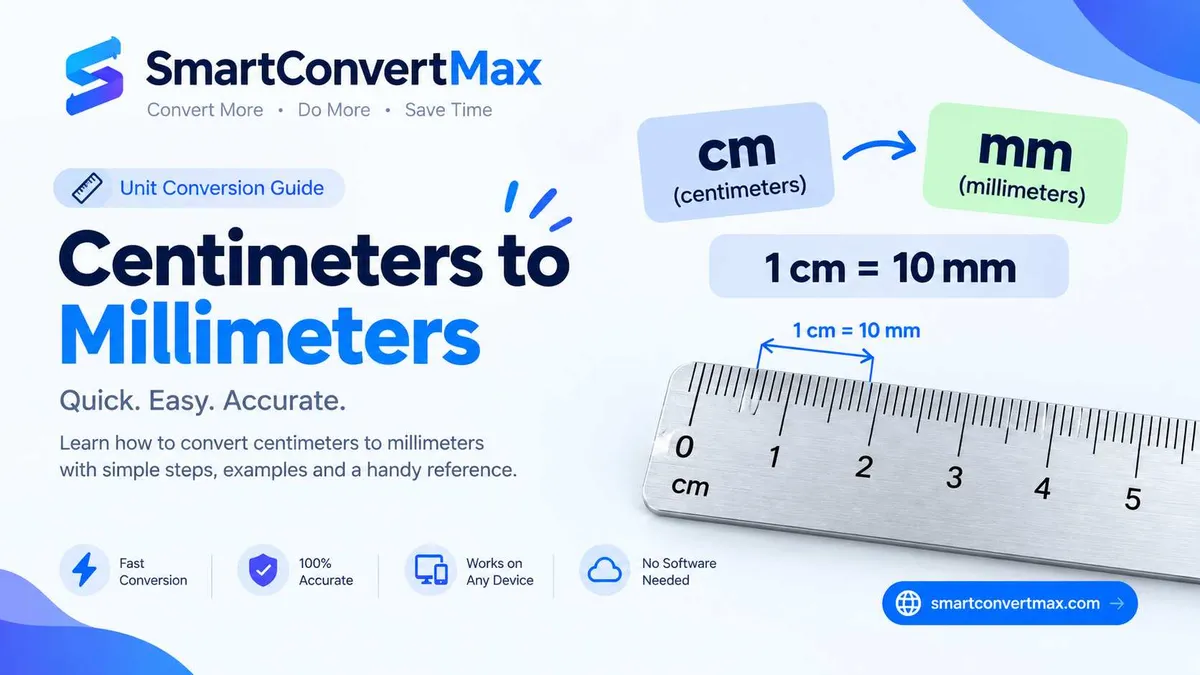
Centimeter to Millimeter: Exact Formula, Chart & Ruler Guide
Centimeter to Millimeter: The Complete Conversion Guide
There are exactly 10 millimeters in 1 centimeter. To convert centimeters to millimeters, multiply the number of centimeters by 10. So 20 cm equals 200 mm, and 8 cm equals 80 mm. The reverse works the same way — divide millimeters by 10 to get centimeters.
This is the simplest conversion in the entire metric system. There is no decimal factor to memorize, no rounding required, and no ambiguity. One centimeter has always been 10 millimeters, and it always will be.
This guide gives you the exact formula, a quick-reference chart, practical ruler-reading tips, and real-world examples across woodworking, tailoring, 3D printing, and everyday measurements.
If you want the instant number, the unit converter on SmartConvertMax handles it in one click.
How Many Millimeters in a Centimeter?
There are exactly 10 millimeters in 1 centimeter. This is not an approximation — it is the definition of the centimeter within the International System of Units (SI).
The centimeter is one-hundredth of a meter. The millimeter is one-thousandth of a meter. Since 100 ÷ 1,000 = 0.1, one millimeter equals one-tenth of a centimeter, and one centimeter equals ten millimeters.
The BIPM SI Brochure confirms this relationship as part of the metric system. The NIST Special Publication 811 documents it for US applications. Both sources agree — the ratio has never changed since the metric system was introduced during the French Revolution.
The Exact cm to mm Formula
To convert centimeters to millimeters, multiply the number of centimeters by 10.
Formula: millimeters = centimeters × 10
That is all you need. To go the other way, from mm to cm, divide by 10.
Direction | Formula | Example |
|---|---|---|
Centimeters → Millimeters | cm × 10 | 8 cm = 80 mm |
Millimeters → Centimeters | mm ÷ 10 | 80 mm = 8 cm |
If you work with other length units too, our guides on converting inches to centimeters, millimeters to inches, and feet to inches follow the same logic.
How to Convert Centimeters to Millimeters (Step by Step)
If you want to run the calculation manually, here is the cleanest process:
Write down the value in centimeters. For example, 20 cm.
Multiply by 10. So 20 × 10 = 200.
Add the unit. The result is 200 mm.
Verify with the reverse formula. Divide 200 by 10 and you get back to 20.
This four-step method works for any value, whether you are converting 8cm to mm, 10 cm to mm, or 300 cm to mm. The mental math is trivial because multiplying by 10 just shifts the decimal point one place to the right. 20.0 becomes 200.0. 8.5 becomes 85.0.
If you are working from a scanned spec sheet or a photo of a measurement chart, the OCR image tool pulls the numbers out so you can convert them digitally.
Centimeter to Millimeter Conversion Table (Quick Reference)
The table below covers the values people search for most often. Bookmark it or keep it handy — it answers the majority of everyday conversion questions at a glance.
Centimeters | Millimeters | Centimeters | Millimeters |
|---|---|---|---|
0.5 cm | 5 mm | 15 cm | 150 mm |
1 cm | 10 mm | 20 cm | 200 mm |
2 cm | 20 mm | 25 cm | 250 mm |
3 cm | 30 mm | 30 cm | 300 mm |
4 cm | 40 mm | 40 cm | 400 mm |
5 cm | 50 mm | 50 cm | 500 mm |
6 cm | 60 mm | 75 cm | 750 mm |
7 cm | 70 mm | 100 cm | 1,000 mm |
8 cm | 80 mm | 150 cm | 1,500 mm |
9 cm | 90 mm | 200 cm | 2,000 mm |
10 cm | 100 mm | 250 cm | 2,500 mm |
12 cm | 120 mm | 300 cm | 3,000 mm |
For values not listed, the unit converter returns the exact figure in seconds. If you want to save or share the table, the Word to PDF converter turns it into a clean, print-ready file.
Understanding the Centimeter
The centimeter (symbol: cm) is a metric unit equal to one-hundredth of a meter. It is the standard unit for everyday small measurements in most of the world — clothing sizes, furniture dimensions, rainfall, and human height in many countries.
Its clean decimal structure makes it easy to work with. One meter equals 100 centimeters. One centimeter equals 10 millimeters. There are no awkward fractions like 1/12 or 5,280 to remember.
The prefix "centi" comes from the Latin word for "hundred," and it means one-hundredth. This is why there are 100 centimeters in a meter.
Understanding the Millimeter
The millimeter (symbol: mm) is a metric unit equal to one-thousandth of a meter. It is the standard unit for precision work — engineering tolerances, machining, 3D printing, jewelry, and any application where small differences matter.
Its clean decimal structure is the same as the centimeter's. One meter equals 1,000 millimeters. One centimeter equals 10 millimeters.
The prefix "milli" comes from the Latin word for "thousand," and it means one-thousandth. This is why there are 1,000 millimeters in a meter.
Why the Metric System Uses Powers of 10
The metric system was designed during the French Revolution to replace the chaotic patchwork of regional units that existed before it. The designers chose powers of 10 deliberately.
The idea was that any conversion between metric units should be as simple as moving a decimal point. No fractions, no memorized ratios, no conversion tables needed. One hundred centimeters in a meter. One thousand millimeters in a meter. Ten millimeters in a centimeter.
This is why cm-to-mm is one of the easiest conversions in the world. It is not a coincidence — it is by design.
Real-World Applications
Woodworking and Carpentry
Woodworkers in metric countries plan cuts in millimeters, but plans and client requests often come in centimeters. A cabinet door that is 40 cm wide is 400 mm. A shelf that is 2.5 cm thick is 25 mm.
Getting this conversion wrong produces a 10x error — the single most common mistake in metric woodworking. A 400 mm cut that becomes 40 mm is a destroyed piece of material. Always double-check the scale on your ruler before making a cut.
If you are compiling a cut list with multiple parts, the merge PDF tool combines all the sheets into one file, and the compress PDF tool keeps the size manageable for email.
Tailoring and Fashion
Fabric patterns are often written in centimeters, while some measuring tapes show only millimeters on the fine scale. A 20 cm seam allowance is 200 mm. A 1.5 cm hem is 15 mm.
Precision matters here. A millimeter of difference on a seam is negligible, but a 10x error makes a garment unwearable. If you are comparing size charts from different brands, the remove spaces tool and remove duplicates tool tidy up the spreadsheet formatting.
3D Printing
3D printing is a millimeter-scale hobby. Filament diameter is measured in mm (1.75 mm or 2.85 mm). Nozzle sizes are measured in mm (0.4 mm, 0.6 mm, 0.8 mm). Layer heights are measured in mm (0.1 mm, 0.2 mm).
But when you design a part in CAD software, you might work in centimeters or millimeters depending on your region. Converting between the two ensures your print comes out at the right size. A 5 cm tall model is 50 mm tall. A 10 cm base is 100 mm wide.
Jewelry and Precision Craft
Jewelers work in millimeters. Ring sizes, band widths, and stone dimensions are all measured in mm. A 1.5 cm ring band is 15 mm wide. A 2 cm pendant is 20 mm across.
If you are ordering supplies from an international seller, the translate text tool can handle the product descriptions, and the unit converter handles the dimensions.
Schoolwork and Science Labs
Students learn the metric system early, and cm-to-mm is one of the first conversions they master. A pencil is about 18 cm long, or 180 mm. A paperclip is about 3 cm, or 30 mm. A grain of rice is about 5 mm, or 0.5 cm.
If you are a student tracking grades alongside your lab work, the CGPA calculator and GPA to percentage tool help you keep academic records organized. And if your assignment needs a word count check before submission, the word counter gives you the number instantly.
Engineering and Manufacturing
Engineering tolerances are measured in millimeters. A ±0.5 mm tolerance on a machined part is tighter than a ±1 mm tolerance. Blueprints and GD&T callouts use millimeters almost exclusively, even in the US.
Converting from centimeters to millimeters is routine when reading older specs or when working with European suppliers. The percentage calculator helps you work out how far a measurement deviates from spec.
How to Read a Ruler Without Making a 10x Error
This is where most mistakes happen. A ruler with both cm and mm markings has two different scales, and reading the wrong one produces a 10x error.
Here is how to tell them apart:
The large numbers (1, 2, 3, ...) usually mark centimeters.
The smallest tick marks between them are millimeters.
There are 10 mm marks between each cm mark. Count them: 1, 2, 3, 4, 5, 6, 7, 8, 9, and then the next line is the following centimeter.
The halfway mark between two cm numbers is 5 mm.
Warning: If your ruler only has millimeter markings with no cm labels, count to 10 to find the cm mark. If your ruler only has cm markings with no fine mm marks, you cannot measure precisely in millimeters — use a caliper instead.
Common Mistakes to Avoid
Multiplying by 100 instead of 10. A meter has 100 cm, but a cm has only 10 mm. Mixing these up produces a massive error.
Reading the wrong ruler scale. A 2 cm mark and a 2 mm mark look similar on some rulers. Check the labels before you measure.
Forgetting that 1 cm is bigger than 1 mm. A centimeter is ten times longer than a millimeter. If someone says a millimeter is bigger, they are confusing the prefix meanings.
Dropping a decimal place. 8.5 cm is 85 mm, not 8.5 mm. Multiplying by 10 shifts the decimal one place.
Using inches instead of cm. Inches are not part of the metric system. 1 inch equals 25.4 mm, which is a completely different ratio.
If you need to compare two versions of a spec sheet to catch a value that changed between revisions, the text diff checker highlights exactly what shifted.
Tools for Converting Centimeters to Millimeters
You have several options depending on your needs:
Online unit converter: Fast, free, and accurate. The SmartConvertMax unit converter handles cm, mm, meters, inches, and more in one place.
Smartphone apps: Useful for field workers and shoppers who need conversions offline.
Spreadsheet formulas: In Excel or Google Sheets, multiply the cm value by 10 for mm, or divide mm by 10 for cm. Export the sheet afterward with Word to PDF or turn it into slides with PDF to PowerPoint.
Digital calipers: Measure directly in mm or cm with a single button press.
Voice assistants: Asking "Hey Google, how many mm in a cm?" returns a spoken answer in seconds. If you want a written conversion note read aloud, the text to speech tool turns it into audio.
For bulk conversions across dozens of values, the text summarizer condenses long reference documents into quick notes. And if you need to embed a diagram of ruler markings into a document, the image to base64 tool encodes it for web use.
Frequently Asked Questions
How many millimeters in a centimeter?
There are exactly 10 millimeters in 1 centimeter.
How many millimeters are in 1 cm?
1 cm equals exactly 10 mm. This ratio has never changed since the metric system was introduced.
Is 10 mm the same as 1 cm?
Yes. 10 mm and 1 cm are identical measurements. The terms are interchangeable.
How do I convert cm to mm?
Multiply the number of centimeters by 10. For example, 20 cm × 10 = 200 mm.
What is 20 cm in mm?
20 cm equals 200 mm.
What is 8 cm in mm?
8 cm equals 80 mm.
How many mm is 10 cm?
10 cm equals 100 mm.
How do I convert mm to cm?
Divide the number of millimeters by 10. For example, 80 mm ÷ 10 = 8 cm.
What is the formula for cm to mm?
millimeters = centimeters × 10.
Which is bigger, cm or mm?
A centimeter is bigger. 1 cm equals 10 mm, so a centimeter is ten times longer than a millimeter.
Conclusion
The centimeter-to-millimeter conversion is the simplest one in the metric system. Multiply centimeters by 10 to get millimeters, or divide millimeters by 10 to get centimeters. The ratio has never changed, and it is confirmed by both the NIST and the BIPM.
For quick answers, use the conversion table above. For precision work, use the SmartConvertMax unit converter — it carries the full decimal value and handles other units alongside length. If you are working with length conversions more broadly, our guides on inches to centimeters, millimeters to inches, and feet to inches cover the adjacent calculations you are likely to need.
Whether you are converting 20cm to mm for a woodworking cut, checking how many millimeters in a cm for a school assignment, or verifying 8cm to mm for a tailoring pattern, the math is the same everywhere in the world.
More guides
guide
Yards to Feet: Exact Formula, Conversion Chart & Real-World Uses
Convert yards to feet instantly. Learn the exact 3:1 formula, a quick conversion chart, and answers to common yard-to-foot questions for fabric and sports.
guide
SmartConvertMax Conversion Hub: Every Tool and Guide in One Place
Your central hub for unit converters, PDF tools, image tools, and writing guides. Find every conversion calculator and how-to article in one place.
guide
Miles to Meters: Exact Formula, Conversion Chart & Running Guide
Convert miles to meters instantly. Get the exact formula, a full conversion chart, running race distances, and answers to common mile-to-meter questions.
guide
Centimeters to Feet: Exact Formula, Height Chart & Conversion Guide
Convert cm to feet instantly. Get the exact formula, a height conversion chart, feet-and-inches output, and answers to common cm-to-ft questions.