Yards to Feet: Exact Formula, Conversion Chart & Real-World Uses
Yards to Feet: The Complete Conversion Guide
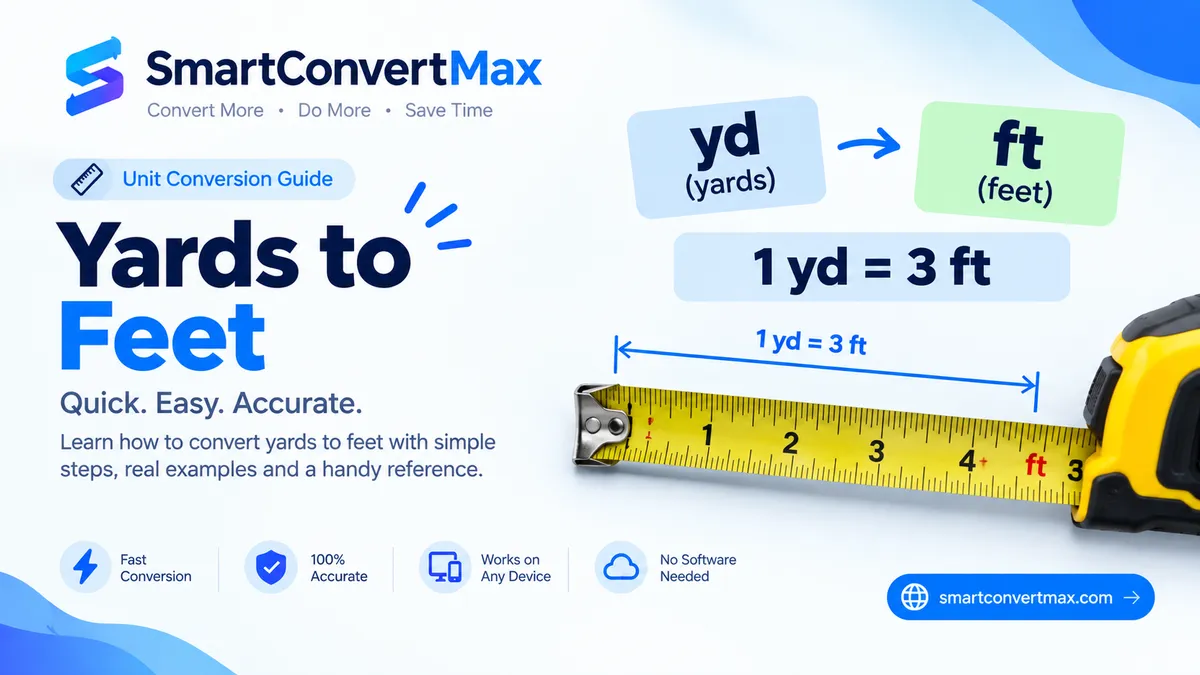
There are exactly 3 feet in 1 yard. To convert yards to feet, multiply the number of yards by 3. So 50 yards equals 150 feet, 10 yards equals 30 feet, and 200 yards equals 600 feet. The reverse works the same way — divide feet by 3 to get yards.
This is one of the simplest conversions in the imperial system. There is no decimal factor to memorize, no rounding required, and no ambiguity. One yard has always been 3 feet, and it always will be.
This guide gives you the exact formula, a quick-reference chart, practical examples across fabric, football, construction, and gardening, plus the mistakes that cause 3x errors.
If you want the instant number, the unit converter on SmartConvertMax handles it in one click.
How Many Feet in a Yard?
There are exactly 3 feet in 1 yard. This is not an approximation — it is the legal definition of the yard within the imperial and US customary systems.
The yard is also 36 inches. Since a foot is 12 inches, three feet make 36 inches, and 36 inches make one yard. The math is clean and has not changed since the 1959 International Yard and Pound Agreement standardized the yard as exactly 0.9144 meters.
According to NIST Special Publication 811, the yard is 0.9144 meters exactly, which translates to 3 feet. The BIPM maintains the metric equivalent for international science and trade. Both sources agree — there is no ambiguity.
The Exact Yards to Feet Formula
To convert yards to feet, multiply the number of yards by 3.
Formula: feet = yards × 3
That is all you need. To go the other way, from feet to yards, divide by 3.
Direction | Formula | Example |
|---|---|---|
Yards → Feet | yards × 3 | 10 yards = 30 feet |
Feet → Yards | feet ÷ 3 | 30 feet = 10 yards |
If you work with other length units too, our guides on feet to inches, inches to centimeters, and millimeters to inches follow the same logic.
How to Convert Yards to Feet (Step by Step)
If you want to run the calculation manually, here is the cleanest process:
Write down the value in yards. For example, 50 yards.
Multiply by 3. So 50 × 3 = 150.
Add the unit. The result is 150 feet.
Verify with the reverse formula. Divide 150 by 3 and you get back to 50.
This four-step method works for any value, whether you are converting 50 yards to feet, 10 yards to feet, or how many feet in 100 yards.
If you are working from a scanned fabric pattern or a blueprint, the OCR image tool pulls the numbers out so you can convert them digitally.
Yards to Feet Conversion Table (Quick Reference)
The table below covers the values people search for most often. Bookmark it or keep it handy — it answers the majority of everyday conversion questions at a glance.
Yards | Feet | Yards | Feet |
|---|---|---|---|
1 | 3 | 100 | 300 |
2 | 6 | 150 | 450 |
5 | 15 | 200 | 600 |
10 | 30 | 250 | 750 |
15 | 45 | 300 | 900 |
20 | 60 | 400 | 1,200 |
25 | 75 | 500 | 1,500 |
30 | 90 | 600 | 1,800 |
40 | 120 | 750 | 2,250 |
50 | 150 | 1,000 | 3,000 |
75 | 225 | 1,500 | 4,500 |
For values not listed, the unit converter returns the exact figure in seconds, including larger values like 500 yards to feet and how many feet is 200 yards. If you want to save or share the table, the Word to PDF converter turns it into a clean, print-ready file.
Understanding the Yard
The yard is an imperial and US customary unit equal to 3 feet, or 36 inches. Its history stretches back to Anglo-Saxon England, where it was originally defined as the distance from the tip of King Henry I's nose to the end of his outstretched thumb.
The modern yard has been standardized since 1959, when the International Yard and Pound Agreement defined it as exactly 0.9144 meters. That is a legal definition, not an approximation.
Today, the yard is most commonly used in:
Fabric and textiles — fabric is sold by the yard in the US
Sports — an American football field is 100 yards long
Construction and landscaping — concrete and soil are measured in cubic yards
Gardening — mulch, sod, and fencing are often sold by the yard
Understanding the Foot
The foot is an imperial unit equal to 12 inches. It is the everyday unit of height and short distance in the US and UK.
The foot has been standardized since 1959 as exactly 0.3048 meters. Three feet make one yard, which means the yard-to-foot ratio is exactly 3:1.
The foot is used for:
Height — a person who is 5 feet 9 inches tall
Room dimensions — a 12-foot ceiling
Short distances — a 6-foot gap
Sports — a 10-foot basketball hoop
For a full breakdown of the foot-to-inch relationship, see our guide on how many inches are in a foot.
Real-World Applications
Fabric and Sewing
Fabric in the US is sold by the yard. A quilting project that needs 5 yards of cotton requires 15 feet of fabric. A dress pattern that calls for 2.5 yards needs 7.5 feet.
If you are comparing fabric prices across stores, some list by the foot and others by the yard. Knowing the 3:1 ratio tells you instantly which is cheaper. A store selling fabric at $6 per yard is charging $2 per foot. A store selling at $2.25 per foot is charging $6.75 per yard.
When you are cleaning up a spreadsheet of fabric prices, the remove spaces tool and remove duplicates tool tidy the formatting quickly.
Football and Sports Fields
An American football field is 100 yards long, which equals 300 feet. That is the distance from goal line to goal line, not counting the end zones.
A 50-yard field goal attempt is 150 feet. A 20-yard pass is 60 feet. Even the announcers' "first and 10" means the offense needs 10 yards — or 30 feet — for a first down.
Swimming also uses yards in some competitions. A 200-yard race is 600 feet. A 500-yard race is 1,500 feet.
Construction and Landscaping
Concrete, soil, mulch, and gravel are sold by the cubic yard, not the linear yard. But fencing, siding, and gutters are measured in linear yards and linear feet.
A fence that runs 40 yards along a property line is 120 feet long. If fence panels come in 8-foot sections, you need 15 panels to cover the run. Getting this wrong means either running short or paying for excess.
When you are combining quotes from multiple contractors, the merge PDF tool bundles them into one file, and the compress PDF tool keeps the size manageable for email.
Gardening
Sod is sold by the square yard, mulch by the cubic yard, and garden rows are often spaced in feet. A garden bed that is 10 yards long is 30 feet, which is plenty of room for a row of tomatoes.
If you are planning a garden layout and need to compare seed spacing charts, the percentage calculator helps you work out coverage rates.
Schoolwork
Students learn the yard-to-foot relationship early. A school hallway that is 30 yards long is 90 feet. A playground that is 50 yards wide is 150 feet. These conversions come up in math problems, science labs, and physical education.
If you are a student tracking grades alongside your work, the CGPA calculator and GPA to percentage tool help you keep academic records organized. And if your assignment needs a word count check before submission, the word counter gives you the number instantly.
Common Mistakes to Avoid
Multiplying by 12 instead of 3. Twelve is the number of inches in a foot, not the number of feet in a yard. Mixing these up produces a 4x error.
Confusing yards with meters. A meter is slightly longer than a yard (1 meter ≈ 1.094 yards). For rough estimates this does not matter, but for precision work it does.
Forgetting that 1 yard is bigger than 1 foot. A yard is three times longer. If someone says a foot is bigger than a yard, they are confusing the units.
Using the wrong unit on a measuring tape. Many tapes show both feet and inches on one edge, and yards on the other. Always check the label before measuring.
Confusing linear yards with square or cubic yards. A linear yard is a length. A square yard is an area. A cubic yard is a volume. They are not interchangeable.
If you need to compare two versions of a project spec to catch a value that changed between revisions, the text diff checker highlights exactly what shifted.
Yards to Feet in Different Regions
The yard is used primarily in the United States and the United Kingdom, with limited use in a few other countries.
United States: Yards are common in fabric, sports, landscaping, and construction. Feet are used for everyday height and short distances.
United Kingdom: Yards are used informally, especially in sports and fabric, but meters are the official unit for most formal measurements.
Metric countries: Meters are the standard. People converting yards are usually working with US or UK specifications.
Sports (global): American football uses yards; most other sports use meters.
If you need to translate a page of conversion notes into another language, the translate text tool can do that without leaving your browser.
Tools for Converting Yards to Feet
You have several options depending on your needs:
Online unit converter: Fast, free, and accurate. The SmartConvertMax unit converter handles yards, feet, inches, meters, and more in one place.
Smartphone apps: Useful for shoppers and contractors who need conversions on the go.
Spreadsheet formulas: In Excel or Google Sheets, multiply the yard value by 3 for feet, or divide feet by 3 for yards. Export the sheet afterward with Word to PDF or turn it into slides with PDF to PowerPoint.
Measuring tape: Most tapes show both feet and inches, and many show yards as well. Read the correct scale before measuring.
Voice assistants: Asking "Hey Google, how many feet in 100 yards?" returns a spoken answer in seconds. If you want a written conversion note read aloud, the text to speech tool turns it into audio.
For bulk conversions across dozens of values, the text summarizer condenses long reference documents into quick notes.
Frequently Asked Questions
How many feet in a yard?
There are exactly 3 feet in 1 yard.
How many feet are in a yard?
1 yard equals exactly 3 feet. This ratio has never changed since the imperial system was standardized.
How many feet in 100 yards?
100 yards equals 300 feet.
How many feet is 200 yards?
200 yards equals 600 feet.
How many feet in 50 yards?
50 yards equals 150 feet.
What is 10 yards in feet?
10 yards equals 30 feet.
How many feet in 500 yards?
500 yards equals 1,500 feet.
Is 3 feet the same as 1 yard?
Yes. 3 feet and 1 yard are identical measurements. The terms are interchangeable.
How do I convert feet to yards?
Divide the number of feet by 3. For example, 90 feet ÷ 3 = 30 yards.
How many feet in a yard of fabric?
One yard of fabric equals 3 feet. Fabric stores in the US sell by the yard, so 5 yards of fabric is 15 feet.
What is the formula for yards to feet?
feet = yards × 3.
Conclusion
The yards-to-feet conversion is one of the simplest in the imperial system. Multiply yards by 3 to get feet, or divide feet by 3 to get yards. The ratio has never changed, and it is confirmed by both the NIST and the BIPM.
For quick answers, use the conversion table above. For precision work, use the SmartConvertMax unit converter — it carries the full value and handles other units alongside length. If you are working with length conversions more broadly, our guides on feet to inches, millimeters to inches, and inches to centimeters cover the adjacent calculations you are likely to need.
Whether you are converting 50 yards to feet for a fabric order, checking how many feet in 100 yards for a football reference, or verifying 200 yards to feet for a landscaping project, the math is the same everywhere in the world.
More guides
guide
Centimeter to Millimeter: Exact Formula, Chart & Ruler Guide
Convert cm to mm instantly. Learn the exact 10:1 ratio, ruler-reading tips, a quick conversion chart, and answers to common centimeter-to-millimeter questions.
guide
SmartConvertMax Conversion Hub: Every Tool and Guide in One Place
Your central hub for unit converters, PDF tools, image tools, and writing guides. Find every conversion calculator and how-to article in one place.
guide
Miles to Meters: Exact Formula, Conversion Chart & Running Guide
Convert miles to meters instantly. Get the exact formula, a full conversion chart, running race distances, and answers to common mile-to-meter questions.
guide
Centimeters to Feet: Exact Formula, Height Chart & Conversion Guide
Convert cm to feet instantly. Get the exact formula, a height conversion chart, feet-and-inches output, and answers to common cm-to-ft questions.