How to Calculate Aggregate Percentage
Aggregate Calculator: Calculate Your Academic Aggregate and Percentage Online
Calculating your academic aggregate can become confusing when you have several subjects, different total marks, and different weightages. Instead of calculating everything manually, an aggregate calculator can help you calculate your marks, percentage, average, weighted average, and overall aggregate more easily. Whether you are a school student, college student, university applicant, or simply checking your academic performance, an online aggregate calculator can save time and reduce common calculation mistakes.
An academic aggregate represents your overall performance across multiple subjects or academic components. Depending on the grading or admission system being used, your aggregate may be based on total marks, percentages, averages, or specific weightages. This is why simply adding marks is not always enough. A calculator that supports different formulas gives you more flexibility when your institution uses a particular method for calculating your final result.
What Is an Aggregate Calculator?
An aggregate calculator is an online tool that helps students calculate their overall academic result using marks, total marks, percentages, and weightages. Instead of calculating every subject separately and then combining the results manually, you can enter your subjects into the calculator and let it perform the required calculations.
For example, suppose you have five subjects. Each subject may have a different obtained mark and total mark. You can enter each subject separately, provide the maximum marks, and allow the calculator to determine the overall result. If your subjects have different importance or weightages, you can also use the weight field to calculate a weighted result.
This makes an aggregate calculator useful for students who want a quick way to understand their overall academic performance without repeatedly using a calculator or spreadsheet.
How Does the Aggregate Calculator Work?
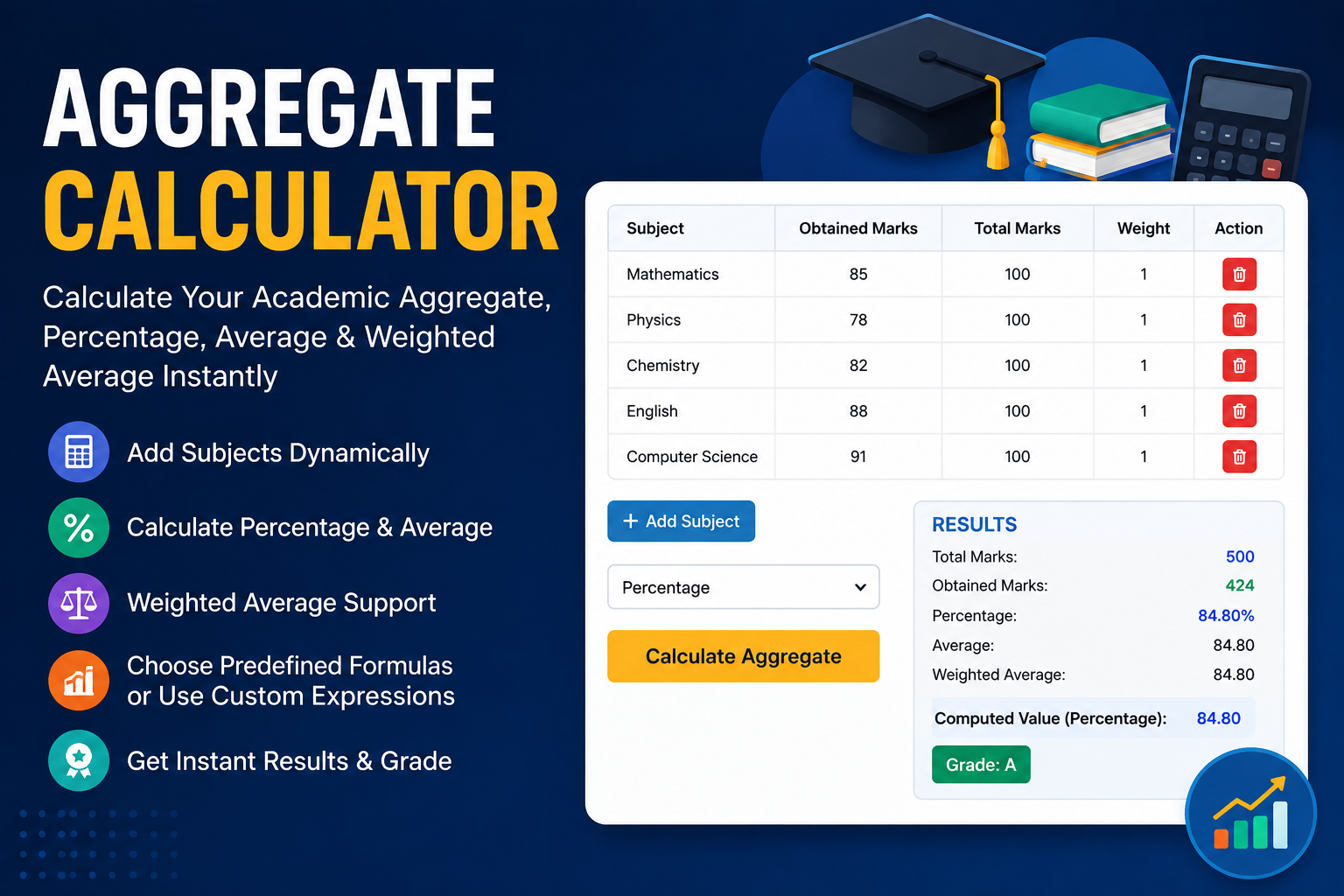
The SmartConvertMax Aggregate Calculator allows you to add subjects dynamically and enter the information required for each subject. You can provide the subject name, obtained marks, total marks, and weight. After entering your information, you can select the calculation method and calculate your result.
The calculator can display several useful results, including total marks, obtained marks, percentage, average, weighted average, computed value, and grade. This gives you more information than simply displaying a single percentage.
The basic process is simple. Add your subjects, enter the marks, enter the total marks, add the appropriate weight if required, select the formula, and click the calculate button. The calculator then processes your information and provides the result.
How to Use an Aggregate Calculator
Using an online aggregate calculator does not require advanced mathematical knowledge. You only need your academic marks and the relevant total marks for each subject.
Add Your Subjects
Start by adding the subjects you want to include in your calculation. Your calculator allows you to add subjects dynamically, which means you can include as many subjects as required for your calculation.
For example, you could enter:
Subject, Obtained Marks, Total Marks, Mathematics 85/100, Physics 78/100, Chemistry 82/100, English 88/100, Computer Science 91/100
Once all subjects have been added, the calculator can use this information to determine your overall result.
Enter Obtained Marks
The obtained marks are the marks you actually received in a particular subject or examination.
For example, if you scored 82 out of 100 in Chemistry, enter 82 as your obtained marks and 100 as the total marks.
Make sure that the values you enter are correct. A small input mistake can change the final aggregate.
Enter Total Marks
The total marks represent the maximum marks available for that subject.
For example:
Obtained Marks = 82
Total Marks = 100
If a subject is worth 150 marks, you should enter 150 rather than 100. Using the correct total marks is especially important when different subjects have different maximum marks.
Add Subject Weight
Your calculator also provides a weight field. Weight can be useful when one subject or academic component contributes differently to the final calculation.
For example, imagine that Mathematics has a weight of 2 while English has a weight of 1. Mathematics will have a greater influence in a weighted calculation.
The correct weight depends on the formula or academic system you are using. If your institution does not use weighted calculations, you should use the standard calculation method instead.
How Is Aggregate Percentage Calculated?
A basic academic percentage can be calculated using:
Percentage = (Obtained Marks ÷ Total Marks) × 100
For example, if a student obtains 850 marks out of 1100:
Percentage = (850 ÷ 1100) × 100
The result is approximately:
77.27%
This is one of the most common methods of calculating an academic percentage.
However, aggregate calculations can be different depending on the academic system. Some institutions calculate the aggregate using total marks, while others assign specific weightages to different examinations or components.
This is why it is important to understand the formula being used rather than assuming that every institution calculates aggregate in exactly the same way.
Aggregate Percentage vs Average Percentage
Aggregate percentage and average percentage can sometimes produce different results.
An aggregate percentage normally combines obtained marks and total marks before calculating the final percentage. For example, if you obtained 80 marks out of 100 in one subject and 40 marks out of 50 in another, you can combine the marks:
Total Obtained = 80 + 40 = 120
Total Marks = 100 + 50 = 150
Then:
Aggregate Percentage = (120 ÷ 150) × 100 = 80%
An average percentage may instead calculate each subject's percentage separately and then calculate the average of those percentages.
In this example:
Subject 1 = 80%
Subject 2 = 80%
Average = 80%
In this particular case both methods produce the same result, but they can differ when subjects have different total marks and different percentages.
What Is a Weighted Average?
A weighted average gives some values more importance than others. This is useful when different subjects, examinations, or academic components have different weights.
For example, imagine three subjects:
SubjectPercentageWeightMathematics90%3Physics80%2English70%1
Mathematics has a greater weight, so it contributes more to the final weighted average.
The basic concept is:
Weighted Average = Sum of (Value × Weight) ÷ Sum of Weights
Using a weighted average can therefore provide a more accurate result when an academic system gives different importance to different components.
If your university or examination system provides an official weighted formula, always follow that formula when calculating your admission or academic aggregate.
What Is a Computed Aggregate Value?
The computed value is the final value produced by the selected calculation method. Depending on the formula you choose, this can represent a percentage, average, weighted average, or another calculated result.
Your calculator provides different formula options so that users can select the calculation method that matches their requirements. This is particularly useful because academic aggregate systems are not identical everywhere.
Before calculating your final result, make sure you understand which formula your school, college, university, or examination authority requires.
How to Calculate Aggregate Manually
You can calculate a basic academic aggregate without an online tool, but the process becomes more difficult as the number of subjects increases.
First, add all the obtained marks.
For example:
85 + 78 + 82 + 88 + 91 = 424
Then add the total marks:
100 + 100 + 100 + 100 + 100 = 500
Now calculate the percentage:
(424 ÷ 500) × 100 = 84.8%
So the student's aggregate percentage is 84.8%.
For a small number of subjects, this calculation is easy. However, if you have many subjects, different total marks, or different weightages, using an aggregate calculator becomes much more convenient.
Why Use an Online Aggregate Calculator?
An online aggregate calculator can make academic calculations faster and easier. Instead of manually adding marks, calculating percentages, and checking formulas, you can enter your information into one tool and receive the result automatically.
It can also reduce simple mathematical mistakes. Students often make errors when adding several marks or accidentally use the wrong total marks. A calculator helps automate these repetitive calculations.
Another advantage is flexibility. If your calculation requires a weighted average or another formula, you can use the appropriate option rather than relying on a basic percentage formula.
Some key benefits include:
Quick academic calculations
Multiple subject support
Percentage calculation
Average calculation
Weighted average calculation
Subject weight support
Automatic result calculation
Grade calculation
Easy online access
Who Can Use an Aggregate Calculator?
An academic aggregate calculator can be useful for many types of students.
School students can use it to calculate their overall subject percentage. College students can use it when checking examination results. University students can use it to estimate their academic aggregate or compare different results.
It can also be useful for students preparing for university admissions. Many admission systems use specific formulas involving previous examination results, entrance test scores, or other academic components. In such situations, students can use an appropriate calculation method to understand their expected aggregate.
However, always check the official admission formula before submitting an application. An online calculator can help you perform the mathematics, but the institution's official formula should be treated as the final authority.
Aggregate Calculator for University Admission
Many students search for an aggregate calculator because they want to estimate their university admission aggregate. Admission calculations can involve several academic components, and each component may have a different percentage or weight.
For example, an admission system might consider school marks, college marks, and an entrance test. If each component has a different weight, simply adding the percentages together will not produce the correct result.
Instead, you need to apply the official weightage to each component.
For example:
ComponentScoreWeightPrevious Examination85%30%Intermediate Examination80%40%Entry Test75%30%
The final aggregate would be calculated using the official weighted formula.
This is why students should identify the exact admission formula before using an aggregate calculator for university applications.
Common Mistakes When Calculating Academic Aggregate
One of the most common mistakes is entering the wrong total marks. If a subject is worth 150 marks but you enter 100, the final percentage will be incorrect.
Another common mistake is confusing average with aggregate. These calculations can produce different results depending on the marks and total marks involved.
Students can also make mistakes when using weightages. A weight of 20% is not the same as simply adding 20 marks to a result. Weightages must be applied according to the relevant formula.
Finally, students sometimes use a general aggregate calculator without checking the official formula required by their university or examination board. Always verify the formula before using a calculated result for an important admission decision.
Aggregate Calculator Example
Let's take a simple example with four subjects.
SubjectObtainedTotalWeightMathematics901001Physics801001Chemistry851001English751001
The total obtained marks are:
90 + 80 + 85 + 75 = 330
The total marks are:
100 + 100 + 100 + 100 = 400
Therefore:
Aggregate Percentage = (330 ÷ 400) × 100 = 82.5%
The student's aggregate percentage is therefore 82.5%.
If different weights were assigned to these subjects, the weighted calculation could produce a different result.
Aggregate Calculator Features
The SmartConvertMax Aggregate Calculator is designed to make academic calculations more flexible. Instead of limiting users to one simple percentage formula, the calculator provides several calculation options.
You can dynamically add subjects, enter obtained and total marks, provide subject weights, select a predefined formula, and calculate the result.
The live preview also allows you to see important information such as:
Total Marks
Obtained Marks
Percentage
Average
Weighted Average
Computed Value
Grade
Having these values available together makes it easier to understand your academic performance instead of looking at only one number.
Frequently Asked Questions
What is an aggregate calculator?
An aggregate calculator is an online tool that helps calculate overall academic performance from multiple subjects, marks, percentages, or weighted components.
How do I calculate my academic aggregate?
For a basic marks-based calculation, add your obtained marks, add the total marks, and use the formula:
Aggregate Percentage = (Total Obtained Marks ÷ Total Marks) × 100
If your institution uses a weighted formula, use the official weightage instead.
Is aggregate the same as average?
No. Aggregate and average can be calculated differently. Aggregate percentage commonly uses total obtained marks divided by total marks, while an average may calculate individual values first and then find their mean.
Can I calculate a weighted aggregate?
Yes. If your academic system assigns different weights to subjects or components, a weighted calculation can be used. Make sure you enter the correct weight for each component.
Can I use an aggregate calculator for university admission?
Yes, but you should first check the official admission formula used by your university. Different universities and programs can use different weightages and calculation methods.
Conclusion
An aggregate calculator is a useful tool for students who want to calculate their academic percentage, average, weighted average, and overall aggregate without performing every calculation manually. By entering subjects, obtained marks, total marks, and optional weights, you can quickly understand your academic performance.
The most important thing is to use the correct formula for your particular situation. A basic academic percentage may be calculated from total obtained marks and total marks, while a university admission aggregate may require specific weightages. Understanding the difference between percentage, average, weighted average, and aggregate can help you avoid calculation mistakes.
If you are checking your examination performance, comparing academic results, or preparing for university admission, an online aggregate calculator can make the process much faster and easier. Just enter your correct marks, select the appropriate calculation method, and verify the result against the official formula when the calculation is being used for admission or another important academic decision.
More guides
guide
Yards to Feet: Exact Formula, Conversion Chart & Real-World Uses
Convert yards to feet instantly. Learn the exact 3:1 formula, a quick conversion chart, and answers to common yard-to-foot questions for fabric and sports.
guide
Centimeter to Millimeter: Exact Formula, Chart & Ruler Guide
Convert cm to mm instantly. Learn the exact 10:1 ratio, ruler-reading tips, a quick conversion chart, and answers to common centimeter-to-millimeter questions.
guide
SmartConvertMax Conversion Hub: Every Tool and Guide in One Place
Your central hub for unit converters, PDF tools, image tools, and writing guides. Find every conversion calculator and how-to article in one place.
guide
Miles to Meters: Exact Formula, Conversion Chart & Running Guide
Convert miles to meters instantly. Get the exact formula, a full conversion chart, running race distances, and answers to common mile-to-meter questions.