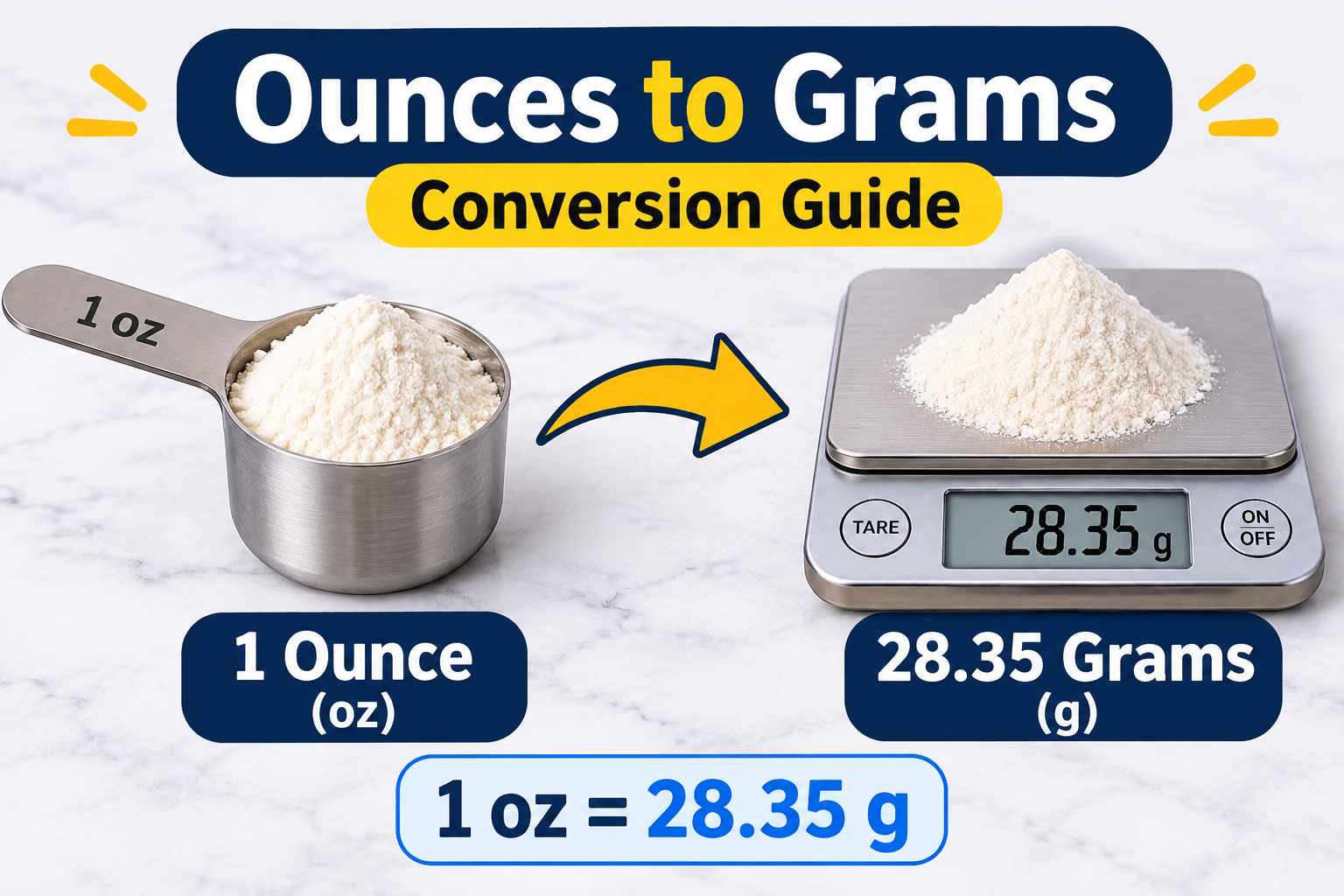
Ounces to Grams (oz to g): Formula, Chart & Troy Ounce
How Many Grams Are in an Ounce?
One ounce equals 28.3495 grams. To convert ounces to grams, multiply by 28.3495. So 5.5 ounces is 155.92 grams. To go the other way, divide grams by 28.3495: 50 grams is 1.764 ounces, and 250 grams is 8.818 ounces.
That factor applies to everyday weights such as food, parcels and body weight. Gold and silver use a different unit, the troy ounce, which weighs 31.1035 grams. Mixing the two is the most common mistake with this conversion, and later sections explain how to avoid it.
For an instant answer, the SmartConvertMax unit converter handles weight conversions for free with no signup.
The Ounces to Grams Formula
Here are the formulas for everyday ounces:
grams = ounces × 28.3495
ounces = grams ÷ 28.3495
For precise work, use the exact value: 1 oz = 28.349523125 g.
For troy ounces, the numbers change:
grams = troy ounces × 31.1035
troy ounces = grams ÷ 31.1035
Direction | Everyday ounce | Troy ounce |
|---|---|---|
Ounces → grams | oz × 28.3495 | oz t × 31.1035 |
Grams → ounces | g ÷ 28.3495 | g ÷ 31.1035 |
How to Convert Ounces to Grams Step by Step
Identify the ounce type. Food, packages and body weight use the everyday (avoirdupois) ounce. Precious metals use the troy ounce.
Pick the factor. Use 28.3495 for everyday ounces, or 31.1035 for troy.
Multiply. For example, 8 oz × 28.3495 = 226.796 g.
Round only at the end. Rounding along the way adds small errors.
A Quick Mental Shortcut
For an estimate, multiply the ounces by 28 and add about 1%. For 5.5 oz, that is 154 + 1.5 = 155.5 g, against an exact 155.92 g. To go the other way, divide the grams by 28 and subtract about 1%.
5.5 Ounces to Grams
5.5 ounces is 155.92 grams. The calculation is 5.5 × 28.3495 = 155.922.
People often type this without the decimal point, as "5 5 ounces to grams", but the weight they mean is five and a half ounces. In other units, 5.5 oz is about 0.156 kg, or 0.344 lb.
A packet of this size is common for cheese, tuna tins and snack bags. If a recipe or label shows 5.5 oz and your scale reads grams, 156 g is close enough for cooking. For baking or anything recorded, use 155.92 g.
Ounces to Grams Conversion Chart
This chart shows both ounce types side by side, so you can see how much the troy ounce differs.
Ounces | Everyday ounce (g) | Troy ounce (g) |
|---|---|---|
1 | 28.35 | 31.10 |
2 | 56.70 | 62.21 |
4 | 113.40 | 124.41 |
5 | 141.75 | 155.52 |
5.5 | 155.92 | 171.07 |
8 | 226.80 | 248.83 |
10 | 283.50 | 311.03 |
12 | 340.19 | 373.24 |
16 | 453.59 | 497.66 |
A pound has 16 everyday ounces, so 16 oz is 453.59 g. If you also need pounds, see our guide on pounds to ounces.
Grams to Ounces: The Reverse Conversion
Going from grams to ounces means dividing by 28.3495. Here are common values:
Grams (g) | Ounces (oz) |
|---|---|
10 | 0.353 |
25 | 0.882 |
50 | 1.764 |
100 | 3.527 |
150 | 5.291 |
200 | 7.055 |
250 | 8.818 |
500 | 17.637 |
1,000 | 35.274 |
How Many Ounces Is 50 Grams?
50 grams is 1.764 ounces, just under 1¾ oz. The calculation is 50 ÷ 28.3495 = 1.7637.
That is about the weight of a small bag of nuts or a single serving of grated cheese. In troy ounces, 50 g is 1.608 oz t, which matters if you are weighing a small gold bar.
How Many Ounces Is 250 Grams?
250 grams is 8.818 ounces. The calculation is 250 ÷ 28.3495 = 8.8185.
That is about 0.55 lb. A 250 g block of butter or a small bag of coffee is roughly 8.8 oz, which is a little more than the 8 oz in two US sticks of butter. In troy ounces, 250 g is 8.038 oz t.
Everyday Ounce vs Troy Ounce vs Fluid Ounce
The word "ounce" covers three different units.
Unit | Measures | Size | Used for |
|---|---|---|---|
Ounce (avoirdupois, oz) | Weight | 28.3495 g, 1/16 lb | Food, parcels, general goods |
Troy ounce (oz t) | Weight | 31.1035 g, 1/12 troy lb | Gold, silver, platinum |
Fluid ounce (fl oz) | Volume | 29.57 mL (US), 28.41 mL (UK) | Liquids and drinks |
A troy ounce is about 9.7% heavier than an everyday ounce. If you use the everyday factor on gold, you understate its weight by about 9%.
A fluid ounce measures space, not weight. One fl oz of water weighs about 29.57 g, but one fl oz of honey weighs more, because honey is denser. Converting fl oz to grams requires the density of the ingredient.
Which Ounce Should You Use?
Situation | Ounce type | Factor |
|---|---|---|
Recipe, food label, packaged goods | Everyday | 28.3495 |
Postal scale, body weight | Everyday | 28.3495 |
Gold, silver, platinum, palladium | Troy | 31.1035 |
Bullion coins and bars | Troy | 31.1035 |
Liquid in a measuring cup | Fluid ounce, needs density | Not a fixed factor |
When you are unsure, look at the context. If it is precious metals, assume troy. If it is food or ordinary goods, assume the everyday ounce.
Where Ounce to Gram Conversions Come Up
Cooking and Baking
US recipes list ounces, while most other countries use grams. A US stick of butter is 4 oz, or 113 g, and a pound of flour is 453.59 g. Many kitchen charts round an ounce to 28 g, which is fine for a casual dish but adds up in a large baking batch.
Gold and Silver
Precious metals are priced per troy ounce. A kilogram gold bar is about 32.15 troy ounces. When a dealer quotes a price per ounce, confirm it is per troy ounce, then convert using 31.1035 g.
Shipping and Postage
Postal scales often show ounces and grams together. International shipments are usually declared in grams, so convert exactly rather than rounding up. Use 28.35 g per ounce as a minimum for declarations and the exact factor for anything billed.
Science and Study
Lab work and coursework use metric units. When a source gives imperial weights, convert with the full factor (28.349523125) and keep the digits until the final answer.
Where the Conversion Factor Comes From
Since the international agreement of 1959, the pound has been defined as exactly 0.45359237 kg. Because an ounce is 1/16 of a pound, it works out to exactly 28.349523125 g. The troy ounce is defined as exactly 31.1034768 g.
NIST Special Publication 811 documents these values, and the BIPM SI Brochure describes the gram and the kilogram within the international system of units. In the United States, NIST Handbook 44 sets the rules for weighing devices used in trade. The UK's national measurement institute is the National Physical Laboratory.
For general background, see the Wikipedia articles on the ounce and the troy ounce. Our guide on kilograms to pounds covers the larger units.
Common Mistakes to Avoid
Using the wrong ounce. The everyday factor on a gold weight understates it by about 9%.
Confusing oz with fl oz. A 12 fl oz can of drink is a volume, not 12 ounces of weight.
Rounding early. Keep all digits until the final answer.
Using 28 g for precise work. It is fine for a quick estimate, but not for baking, postage or anything recorded.
Multiplying when you should divide. Ounces to grams gives a bigger number, and grams to ounces gives a smaller one.
Mixing up 5.5 and 55. A decimal slip changes the answer by a factor of ten.
How to Convert Ounces to Grams in Excel
In Excel or Google Sheets, put the ounce value in cell A1. Use one of these formulas:
Everyday ounces to grams:
=A1*28.349523125or=CONVERT(A1,"ozm","g")Grams to everyday ounces:
=A1/28.349523125or=CONVERT(A1,"g","ozm")Troy ounces to grams:
=A1*31.1034768
The troy formula uses a plain multiplication, because spreadsheet conversion functions may not include the troy ounce. Drag the formula down to convert a whole column.
Other Ways to Convert Ounces to Grams
Online converter: The SmartConvertMax unit converter is free and runs in your browser.
Kitchen scale: Most digital scales switch between ounces and grams with one button.
Calculator: Multiply by 28.3495 or divide by it for the reverse.
Mental math: Multiply by 28 and add about 1%.
Frequently Asked Questions
How many grams is 1 ounce?
One everyday ounce is 28.3495 grams. One troy ounce is 31.1035 grams.
Is 1 ounce exactly 28.35 grams?
28.35 is a rounded value. The exact figure is 28.349523125 grams.
How many grams is 5.5 ounces?
5.5 ounces is 155.92 grams (5.5 × 28.3495).
How many ounces is 50 grams?
50 grams is 1.764 ounces (50 ÷ 28.3495).
How many ounces is 250 grams?
250 grams is 8.818 ounces (250 ÷ 28.3495).
What is the formula to convert ounces to grams?
For everyday ounces, grams = ounces × 28.3495. For troy ounces, grams = troy ounces × 31.1035.
Is a troy ounce the same as a regular ounce?
No. A troy ounce is 31.10 grams, while a regular ounce is 28.35 grams, so the troy ounce is about 9.7% heavier.
How many grams are in an ounce of gold?
An ounce of gold is a troy ounce, which is 31.1035 grams. Do not use the everyday factor for gold.
Why is gold weighed in troy ounces?
The troy system has historical roots in medieval trade and remains the standard for precious metals. It gives bullion coins and bars a consistent weight.
How do I convert fluid ounces to grams?
You need the density of the liquid. One US Fl oz of water weighs about 29.57 g, but denser liquids such as honey weigh more.
How do I convert ounces to grams without a calculator?
Multiply the ounces by 28 and add about 1%. For 8 oz, that is 224 + 2.2 = 226.2 g, close to the exact 226.80 g.
Conclusion
Converting ounces to grams comes down to knowing which ounce you have. For everyday weights, multiply by 28.3495. For gold and other precious metals, multiply by 31.1035. In reverse, divide by the same number.
That gives 155.92 g for 5.5 oz, 1.764 oz for 50 g and 8.818 oz for 250 g. Keep the full digits until the final step, and check the label before you pick a factor, because oz and Fl oz are not the same thing.
For quick answers, use the SmartConvertMax unit converter. For related weight conversions, see our guides on pounds to ounces and kilograms to pounds.
More guides
guide
Pounds to Ounces (lbs to oz): Formula, Chart & Examples
1 lb = 16 oz. Multiply pounds by 16 for ounces, divide ounces by 16 for pounds. See 5 oz, 5 lbs, 32 oz and quarter-pound answers plus a chart.
guide
Kilograms to Pounds & Pounds to Kilograms: Formula, Chart & Converter
Convert kg to lbs and lbs to kg instantly. 148 lbs = 67.13 kg, 134 lbs = 60.78 kg, 60 kg = 132.28 lbs. Exact formula, charts and shortcuts.
guide
Yards to Miles: Formula, Chart, 1,000 & 500 Yard Answers
1,000 yards = 0.5682 miles. Divide yards by 1,760 to get miles. See 500-yard answers, a conversion chart, and how many yards to swim a mile.
guide
Kilometers to Centimeters (km to cm): Formula & Chart
Convert km to cm instantly: 1 km = 100,000 cm. Get the formula, a conversion chart, map scale examples, Excel tips and answers to common questions.